
Is Your AI Project Working? Check These 4 Metrics First

The short answer
Adoption is not the same as business value. To measure whether an AI project actually works, track capacity, cost, conversion, and retention.
When enterprise leaders evaluate an AI project, they usually ask two questions: Did we buy the software? Are employees using it?
Those questions only prove that your team has started experimenting. They do not prove that AI has created business value.
The data confirms this gap. According to the China Entrepreneur AI Application Survey Report 2025, 89.84% of Chinese enterprises reported using AI. Yet MIT Project NANDA's The GenAI Divide (2025) found that while over 80% of companies have tested at least one AI tool, only 5% of custom AI pilots ever reached production and delivered measurable business value. Here, "production" means moving beyond testing into daily business operations. Similarly, McKinsey’s The State of AI in 2025 revealed that in Greater China, only 6% of surveyed companies qualify as "high-performing winners."
While these studies use different methodologies and sample sets, they point to the same reality: adopting AI and achieving business results with AI are two entirely different things.
To determine whether an AI project is delivering real value, look past usage logs and evaluate four core metrics: capacity, cost, conversion, and retention.
| Metric Type | Core Question | Common Measures | Common Pitfall |
|---|---|---|---|
| Capacity | Is the same work completed faster or in higher volume? | Task completion time, output per unit of time, update frequency | Mistaking an initial post-launch usage spike for lasting performance |
| Cost | Does completing the same work cost less? | Unit cost per workflow, labor hours saved, cost-to-output ratio | Overlooking internal labor, training, and ramp-up hours |
| Conversion | Does increased output generate business outcomes? | Attributable leads, conversion rates, repeat purchase rates | Assuming more output automatically equals more revenue |
| Retention | Is the workflow still running reliably after several months? | Sustained usage rate, integration into daily operations, retained internal capability | Evaluating only during the pilot while ignoring post-handover operations |
Each metric answers a distinct question, and none can replace the others. If you only track capacity without retention, you get a temporary spike that collapses once oversight ends. If you track conversion without cost, you cannot tell whether revenue gains justified the investment. If you track cost without conversion, you may end up saving money on work that produces zero business impact.
Before You Evaluate: Define the Pilot Conditions
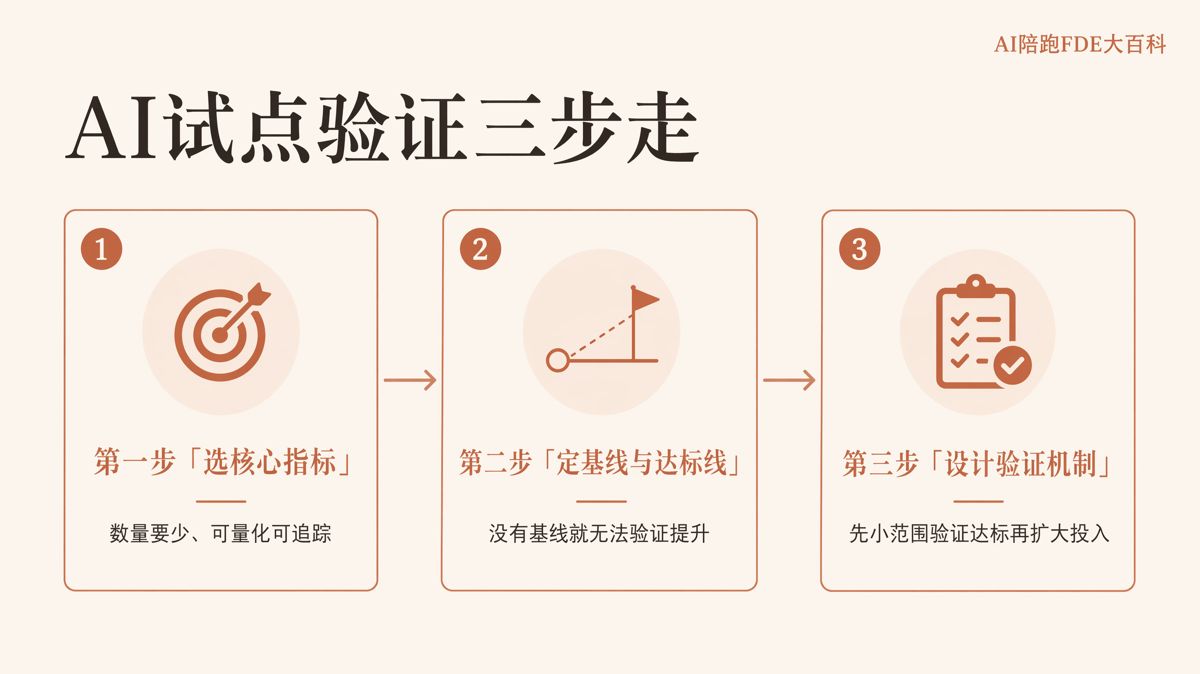
A pilot runs in a limited scope to generate the data needed to decide whether a project deserves continued investment. A valid pilot requires three clear prerequisites: a defined operational scope, quantifiable metrics, and an agreed-upon validation timeline.
Pick a Handful of Core Metrics
Do not overwhelm a pilot with dozens of key performance indicators. Select one or two metrics directly tied to the target workflow that you can log consistently—such as the time needed to draft a single content asset, or monthly output volume produced by the same team size.
Fewer metrics make it easier to isolate whether performance shifts came from the AI implementation. When making your final review, however, you must still evaluate the project across all four categories: capacity, cost, conversion, and retention.
Set Both a Baseline and a Target Threshold
A baseline captures your actual performance before the project begins: how long a deliverable took, how many units your team produced each month, and how much labor and budget that required.
A target threshold defines the specific performance level required within an agreed timeframe for the pilot to pass.
Without a baseline, you cannot quantify improvement. Without a target threshold, an underperforming project can linger indefinitely in "observation mode."
Make sure you standardize the measurement method before logging data. If you measure output differently before and after launch, your calculated efficiency gains cannot be verified.
Agree on Milestones and Exit Terms Upfront
Validate AI implementations in controlled phases before committing larger budgets. A standard pilot runs over 3 to 6 months, structured with 1- to 3-month review milestones.
Before kicking off, put failure terms in writing: workflow adjustments, project termination clauses, or fee-credit mechanisms. These safeguards should be written into your contract rather than left to verbal understandings.
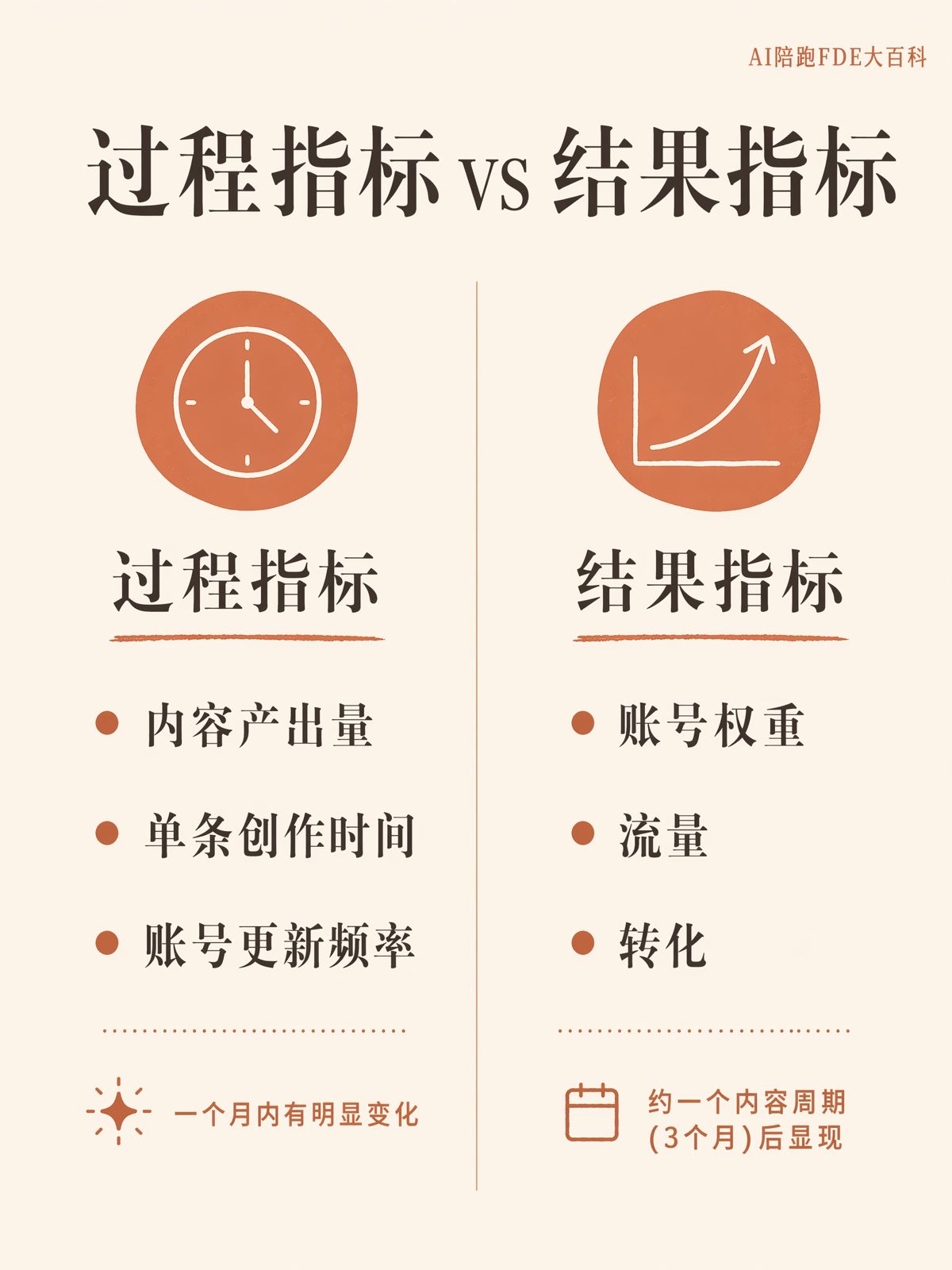
1. Capacity: Are You Doing More Work, Faster?
Capacity shifts are usually the easiest to observe. Track the following data points:
- Time required to produce a single asset or complete a single task
- Number of tasks completed within the same timeframe
- Changes in monthly output under identical headcount
- Publication or release cadence across target workflows
To evaluate these figures accurately, compare them directly against your pre-launch baseline using identical measurement rules.
For example, document how long an asset took to finish and how many pieces were delivered per month prior to the project. Then measure both figures under the exact same operational conditions with AI. Only then can efficiency claims be backed by evidence.
Capacity data must also be tracked over an extended period. Teams often work faster immediately after rollout due to intensive training, executive attention, or sprint goals. That initial spike rarely reflects long-term capacity.

2. Cost: Don't Just Count Software Licenses
Cost metrics answer a straightforward question: Does completing the same work now cost less?
Many companies only factor in software licenses or agency retainers while ignoring internal overhead. The true cost of an AI project includes:
- Platform subscription, API, and third-party implementation fees
- Internal hours spent learning, testing, and adapting to new workflows
- Resources dedicated to training internal staff to manage workflows independently
- The operational cost of the ramp-up period before the workflow stabilizes
Costs must also be tracked separately by workflow. Content generation, customer service, and sales enablement carry distinct cost structures and returns; blending them into a single company-wide pool obscures the truth.
Consolidating everything into one overall budget allows a winning workflow to mask a failing one. When that happens, leaders cannot tell which AI workflows deserve more budget and which should be modified or shut down.
3. Conversion: Output Growth Does Not Equal Business Growth
Conversion metrics verify whether increased AI output translates into trackable leads, closed deals, or repeat purchases.
Publishing more content or finishing tasks faster merely proves higher operational volume. To prove real value, you must track how much business activity those additional outputs actually produced.
Count only conversion events that can be directly attributed to the AI-assisted workflow. Unverified revenue increases or general market tailwinds should never be claimed as AI project returns.

4. Retention: Is the Workflow Still Running Three Months Later?
Retention does not measure launch-week excitement. It measures whether tools, processes, and internal talent continue operating smoothly months down the road.
Audit the following factors:
- Are team members still logging into and using the tools daily?
- Has AI become part of standard daily operations?
- Did workflows revert to old manual habits once management attention shifted?
- Can internal operators run and troubleshoot the process without external vendor support?
You should also verify whether institutional assets remain within your company. Look for concrete deliverables: standard operating procedures (SOPs) that outline every step, accessible internal knowledge bases used by staff and AI models, documented reusable workflows, and skill certifications for internal operators.
If these assets and capabilities are missing, a project that looked successful during the pilot will likely collapse once outside help leaves. The business simply rented a vendor's execution capacity instead of building lasting organizational competence.
Calculate ROI Separately for Each Workflow
Return on investment (ROI) measures net gains relative to total capital and operational expenses. The standard formula applies:
$$\text{ROI} = \frac{\text{Measurable Financial Gains from AI} - \text{Total Investment}}{\text{Total Investment}}$$
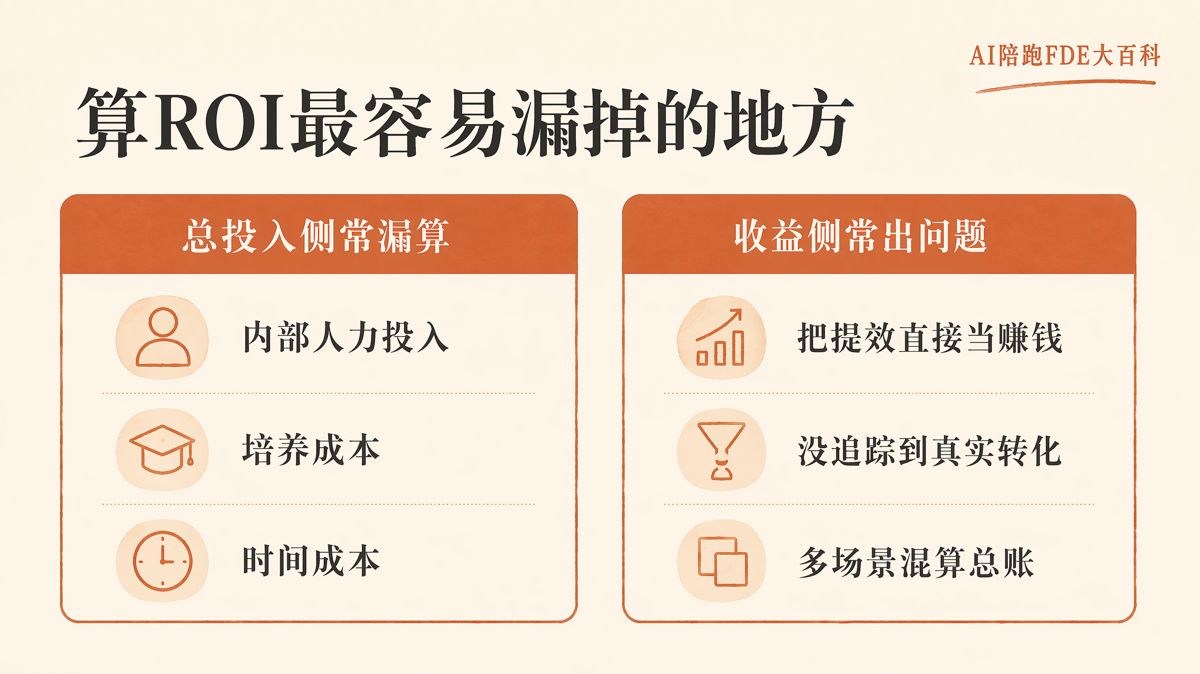
While the formula is simple, enterprise calculations frequently misfire on both sides of the equation.
On the cost side, companies routinely leave out internal labor, training hours, and the productivity dip during onboarding. On the return side, they often confuse operational time savings with actual revenue.
Calculate the complete investment and trackable returns for each specific workflow independently. Avoid averaging numbers across multiple initiatives into a single top-level estimate.
Market analyses typically put the enterprise AI payback period at 2 to 4 years, with a minority of projects recovering costs within 12 months. High-frequency industrial use cases, such as predictive maintenance in manufacturing—where sensor data identifies equipment failure risks before breakdowns occur—have seen reported payback periods as short as roughly 3 months.
However, these benchmarks depend heavily on project scope, digital maturity, and accounting methods. They should not be adopted as universal targets. The only benchmarks that matter are your own historical baselines, actual spending, and verified business outcomes.
Four Flawed Evaluation Traps
1. Equating Software Purchases with Success
Procuring software only means you have gained access to a capability. Real value can only be measured after tools are integrated into active workflows and generate verified operational improvements.
2. Confusing Completed Training with Organizational Capability
Training sessions teach employees how a tool functions; they do not guarantee that employees will adopt it permanently or that the company has built a reliable workflow.
Research from both MIT NANDA and McKinsey points to bottlenecks in data architecture, workflow integration, cross-team collaboration, talent readiness, and governance. Completing a software workshop without sustained workflow integration does not make a project successful.
3. Taking Vendor Marketing Claims at Face Value
Many service providers market promises like "results in 30 days" or "300% order growth." These claims are vendor marketing narratives. Without third-party audits, they should never be viewed as industry standards, let alone adopted as internal performance thresholds.
Your pilot targets should be grounded in your historical baselines, specific workflows, and actual resource commitments.
4. Tracking ROI While Ignoring Capability Retention
A positive ROI during a pilot is merely a temporary snapshot. You must also evaluate whether your internal team can operate the system independently, and whether documented SOPs, knowledge bases, and reusable workflows stay within the business.
If an initiative grinds to a halt the day an external partner steps away, the pilot's performance cannot be sustained.
The Four Questions Every AI Project Must Answer
When evaluating an enterprise AI deployment, ensure you can answer four fundamental questions:
- How much did capacity change for the target workflow?
- How much did total costs shift to deliver that same work?
- How many trackable business outcomes did those operational shifts generate?
- Are the tools, workflows, and skills still embedded in the organization months later?
Each metric requires a documented baseline from before launch and a clear performance threshold set for the pilot window. Once the pilot concludes, calculate costs and returns separately for each workflow.
When you can answer these four questions with concrete data, you have real evidence of AI performance. Simply reporting that software was purchased, training was completed, and people are using the tools is not proof of business value.
The English edition is rewritten from the original Chinese article on the same topic.

Starbox AI is an AI marketing company based in Hangzhou, China. This article draws on Starbox project work. Please credit the source when quoting.
Related reading
 AI Adoption
Can One AI Operator Really Replace 10 People?
Claims of 10x headcount cuts count generation speed, not QA and rework. Real efficiency measures net pipeline hours saved.
Oct 22, 2026 · 6 min read
 AI Adoption
Bought Basic AI and Seeing Zero ROI? A 4-Step Activation Playbook
Activating entry-level AI is not about model parameters. Turn open chat boxes into defined operational stations with clear inputs, templates, and QA checklists.
Oct 22, 2026 · 6 min read
 AI Adoption
Why One-Click AI Fails at Work: How to Pick Enterprise Agents
One-click AI tools seem easy, but their first-draft accuracy is terrible. Real business ROI requires multi-step workflows with your own knowledge base.
Oct 21, 2026 · 6 min read