
Enterprise AI ROI: Don't Just Count Software Costs

The short answer
Real AI ROI requires tracking specific use cases, turning efficiency into hard data, and counting internal labor alongside software costs.
When companies decide whether to keep funding an AI project, a familiar scene plays out: finance brings the software invoices, business units claim efficiency is up, and project teams point to increased output or faster turnaround.
These details help, but they are not enough to calculate return on investment.
ROI measures the net financial gain generated by an investment. The basic formula is straightforward:
AI Adoption ROI = (Quantifiable Returns - Total Investment) / Total Investment
The math is simple. The hard part is replacing subjective impressions—like "things feel faster," "volume is up," or "customer response is quicker"—with auditable operational metrics, while capturing all internal labor, implementation, training, and time costs beyond software licenses.
If your return is just "improved efficiency" and your cost is only tool subscriptions, your ROI figure may look impressive, but it cannot tell you if the initiative is truly worth keeping.
A decision-grade AI business case requires three things: accounting by specific use case, translating outcomes into operational business data, and including internal costs that never generated an external invoice.
Using AI Does Not Equal Business Returns
MIT Project NANDA published a preliminary study in 2025, The GenAI Divide, analyzing more than 300 publicly disclosed AI initiatives, interviewing 52 organizations, and surveying 153 senior executives.
The report found that within its sample, 95% of organizations had not yet realized a return on their generative AI investments. Only 5% of integrated AI pilots delivered millions of dollars in value. At the same time, more than 80% of organizations had already evaluated or piloted general tools such as ChatGPT and Copilot.
This finding does not mean people are not using AI. It highlights how difficult it is to turn exploratory usage into sustained, measurable business returns. The authors note that these figures draw partly from qualitative interviews with varying sample sizes and success definitions, so they reflect broader market trends rather than a universal failure rate.
Adoption among Chinese enterprises is equally widespread. The Beijing News Shell Finance released the Chinese Entrepreneurs AI Application Survey Report (2025), covering 128 companies, where 89.84% of respondents reported using AI across various operational workflows.
Another benchmark comes from McKinsey's The State of AI in 2025: Global Survey. Surveying 1,993 respondents across 105 countries, McKinsey identified roughly 6% as "AI high performers"—organizations where AI contributed more than 5% of earnings before interest and taxes (EBIT) alongside significant business value.
The 89.84% adoption rate in China and McKinsey's 6% high-performer rate use different samples, regions, and metrics; they cannot be directly compared. Together, however, they illustrate two realities: using AI is now common, but proving that AI drives measurable operational impact requires far stricter accounting.

Set Your Scope: Track One Use Case at a Time
Do not attempt to measure company-wide AI ROI on day one.
Overall revenue reflects product quality, pricing, sales execution, channel distribution, and market conditions. Isolating AI's exact contribution at that level is nearly impossible. Different AI use cases also track completely different outcomes: content production focuses on output volume and unit cost, customer support tracks resolution time and ticket volume, and other projects have their own operational key performance indicators.
Blending multiple initiatives into a single balance sheet lets high-performing projects mask underperforming ones, leaving leadership unable to tell which investments actually work.
A better approach: select one clearly defined operational scenario with traceable data, and track its costs and returns independently.
For example, if you are evaluating AI in marketing content creation, track only output volume, unit cost, labor hours, and directly related business outcomes before and after deployment. Leave revenue fluctuations from other departments out of the equation.
The narrower your scope, the easier it is to audit the data and decide whether the model can be scaled elsewhere.
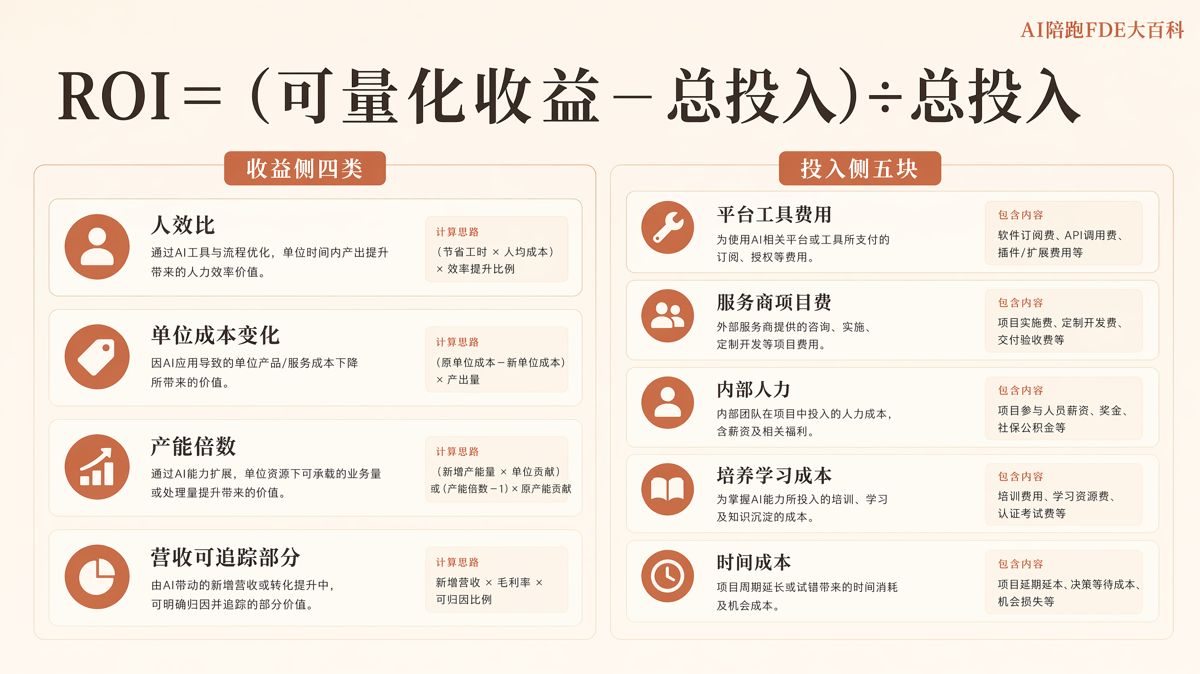
How to Measure Returns: Break "Efficiency" into Four Metrics
To count as project returns, your data must follow consistent standards and be verifiable through timesheets, business software logs, financial records, or project ledgers. These metrics fall into four categories:
1. Labor Productivity
Track how many people, how many labor hours, and how much finished work a specific role or workflow requires before and after AI adoption.
Do not use vendor benchmark multipliers or rely on staff sentiment about feeling faster. Record actual hours worked against actual output delivered, then compare the difference.
2. Unit Cost
Measure the fully loaded cost to deliver one customer interaction, execute one workflow, or produce one asset before and after AI adoption.
Looking only at gross departmental spend can mislead you. If your overall business volume grows, total spend might rise while unit costs drop significantly. Conversely, if business volume drops, a decline in total spend does not necessarily mean your process became more cost-effective.
3. Production Capacity
Measure changes in total output under identical or comparable staffing levels and timeframes.
Higher capacity proves your workflow has expanded its throughput. However, a blanket statement like "overall efficiency improved" cannot replace separate, verifiable numbers for capacity, labor hours, and unit costs. Track all three individually.
4. Attributable Revenue or Acquisition
When AI enhances content production, response times, or conversion rates, count only the revenue or leads backed by tracking records that tie directly to that specific initiative.
Use lead-source tagging, customer journey logs, and pre- and post-launch control groups. Never credit company-wide topline growth entirely to an AI implementation.
You do not need to apply all four metrics at once. Match your metrics to the problem: if you want lower costs, monitor unit cost; if you need more volume, monitor capacity under constant headcount; if you want customer acquisition, establish clear attribution mechanisms beforehand.
Note that operational gains do not automatically convert into cash savings. Whether saved hours or higher capacity should be converted into a monetary value—and at what rate—must be defined in advance with your finance team. If an operational metric cannot be converted into cash on an agreed basis, report it as an operational improvement rather than forcing it into a financial ROI formula.

How to Measure Investment: Internal Hours Are Real Costs
Many organizations calculate AI investments by adding up tool subscriptions and software fees. That approach leaves out major cost drivers.
Every AI project should account for at least five expense categories:
- Software, platform, and tool subscriptions or license fees;
- Implementation, customization, or external enablement fees;
- Internal labor hours spent on scoping, testing, reviewing, and acceptance;
- Internal team training and the ramp-up time needed to reach operational proficiency;
- Time and organizational resources tied up from kickoff until the workflow delivers business value.
Internal team members do not generate an external vendor invoice, but their time is an operational cost diverted from other priorities. Ramp-up periods also consume real resources. If you omit these, your ROI calculation will be inflated.
Different companies price internal labor and overhead differently, but your cost-accounting standards must stay consistent before and after launch. Be careful to avoid double counting—if training time is already logged in internal labor hours, do not record it a second time under general overhead.
A comprehensive cost model might lower your initial paper ROI. But that realistic number is the only figure you can trust to decide whether to continue, adjust, or scale a deployment.

Five Common Accounting Mistakes
| Common Practice | Core Problem |
|---|---|
| Attributing total company revenue growth entirely to AI | Revenue is driven by multiple factors; AI's exact share cannot be isolated this way |
| Counting only software subscription fees | Ignores internal labor, training, and rollout costs, artificially inflating ROI |
| Treating subjective "faster workflows" as quantifiable returns | Lacks verifiable records, preventing pre- and post-launch audits |
| Blending multiple AI pilots into one calculation | Different use cases have distinct economics; aggregated numbers hide weak performers |
| Relying on industry-average payback benchmarks | Benchmarks ignore your baseline, process maturity, and execution reality |
The problem in these cases is not the math—it is the measurement scope. If you do not define where returns come from, what costs are included, and how data is recorded upfront, the final number cannot guide executive decisions.
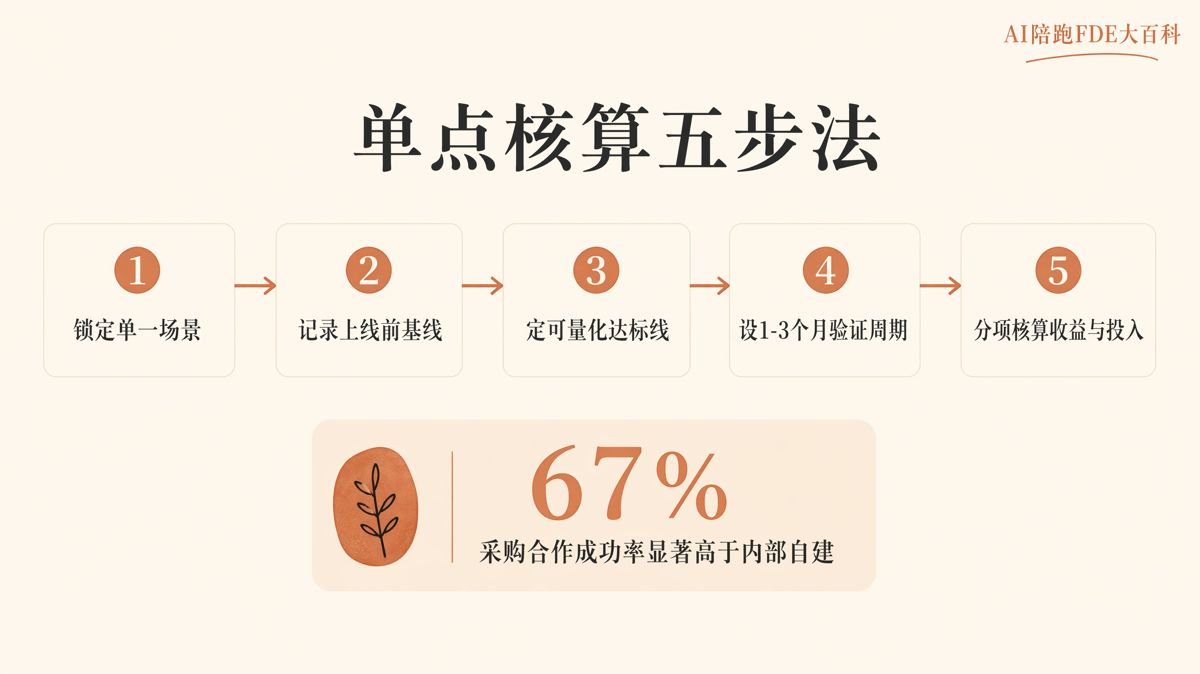
A Six-Step Process for Auditing AI ROI
Step 1: Select a Specific Use Case
Define the business problem first, then restrict the deployment to a self-contained, measurable operational workflow.
In the pilot phase, prioritize workflows that show results quickly, maintain reliable historical baselines, and do not require major core-system overhauls. This setup makes pre- and post-launch data much cleaner to verify.
Step 2: Establish a Pre-Launch Baseline
Before introducing AI, log existing output volume, unit costs, labor hours, turnaround times, and relevant performance metrics. This baseline forms the benchmark for every subsequent comparison.
Without baseline data, you will not be able to quantify the exact operational shift after rollout.
Step 3: Define Clear Success Criteria Upfront
Avoid vague plans like "let's run it for a while and see." Agree beforehand on which metric must hit what target within what timeframe to qualify as a successful investment.
Your success criteria must align directly with the core problem. If the goal is cost containment, audit unit costs; if the goal is throughput, audit volume under identical conditions.
Step 4: Set a Verification Window
For fast-moving workflows with clear operational data, run the first audit within one to three months. More complex workflows may require three to six months to generate auditable patterns.
Use these timeframes as directional guides. Set your evaluation window based on your operational cycle, data maturity, and workflow complexity rather than applying a rigid corporate deadline to every project.
Step 5: Tally Returns and Total Costs Separately
Once the verification window closes, audit business performance against your agreed baseline. Convert eligible operational gains into monetary returns based on your pre-approved financial criteria.
Next, tally software licenses, professional services, internal labor, training, and transition time, then run the formula:
AI Adoption ROI = (Quantifiable Returns - Total Investment) / Total Investment
Base every calculation on logged operational records rather than general team feedback.
Step 6: Decide Next Steps Based on Audited Data
If the pilot meets its pre-set benchmark, evaluate scaling it to adjacent teams or workflows.
If it falls short, follow your predefined protocol: refine the implementation, extend the evaluation window, or shut the project down. Never move the goalposts after results come in.
Do Not Linearly Project Pilot Numbers Company-Wide
While you can estimate the potential impact of broader adoption during a pilot, make it clear that pilot projections are hypotheses, not enterprise-wide ROI forecasts.
As adoption spreads across an organization, staffing structures, management overhead, training requirements, and cross-functional coordination change significantly. The unit economics and productivity gains achieved by an agile pilot team cannot simply be multiplied by your total headcount.
The safer route is sequential: validate one specific scenario, verify its net returns, and expand step by step. Every new use case requires its own baseline, accounting scope, and success criteria. Never use the first project's numbers as a substitute for auditing the next one.
Build vs. Buy Depends on Delivery Capability
The MIT Project NANDA report also examined deployment methods. Within its interview sample, approximately 67% of custom, externally partnered tools with continuous learning capabilities made it to production deployment, compared to about 33% of tools built entirely in-house.
This data point needs proper context. It does not represent an industry-wide success rate, nor does it guarantee that working with external vendors ensures success. The authors noted that these figures reflect interviews across 52 organizations with varying definitions of success, procurement maturity, technical foundations, and risk tolerances.
What it does indicate is that AI outcomes depend on more than the software itself. Success relies heavily on how well tools integrate into existing workflows, how effectively they adapt to operational feedback, and how projects are structured and audited.
Whether building internally or working with outside partners, define your business objectives, data tracking methods, and acceptance criteria before writing code or signing contracts. Without them, even a deployed tool cannot prove its business value.
Payback Periods Cannot Be Copied from Case Studies
A payback period is the time required for cumulative net returns to cover an initiative's total initial and ongoing costs.
Marketing case studies cite payback timelines ranging from several months to several years. This wide spread occurs because different initiatives vary significantly in capital investment, usage frequency, operational baselines, and monetization models.
Industry benchmarks can help calibrate initial expectations, but they cannot serve as your internal acceptance target. Calculate your own payback period using your full cost model, baseline data, and verified returns.
A longer payback period does not automatically make an initiative unviable. Evaluate the strategic importance of the workflow, the total capital commitment, and the potential to replicate the capability elsewhere. The key is establishing transparent timelines and acceptance standards upfront, preventing misaligned expectations across leadership later on.
ROI Exists to Drive Operational Decisions
Calculating AI ROI is not an exercise in justifying past spending. It exists to answer direct operational questions:
- Did this specific workflow generate auditable business outcomes?
- What did the business actually spend to achieve those outcomes?
- If the initiative missed its targets, what was the root cause?
- Should we expand the rollout, refine the workflow, or cut the project?
- Can this operational playbook be applied to adjacent use cases?
Calculating enterprise AI ROI means looking beyond software invoices and subjective impressions.
Select a focused use case, log pre-launch baselines, agree on success criteria and review cycles, and track verified returns against full internal and external costs. With clean data in hand, leadership can clearly see what AI has improved, by how much, and where to allocate the next dollar of capital.
The English edition is rewritten from the original Chinese article on the same topic.

Starbox AI is an AI marketing company based in Hangzhou, China. This article draws on Starbox project work. Please credit the source when quoting.
Related reading
 AI Adoption
Can One AI Operator Really Replace 10 People?
Claims of 10x headcount cuts count generation speed, not QA and rework. Real efficiency measures net pipeline hours saved.
Oct 22, 2026 · 6 min read
 AI Adoption
Bought Basic AI and Seeing Zero ROI? A 4-Step Activation Playbook
Activating entry-level AI is not about model parameters. Turn open chat boxes into defined operational stations with clear inputs, templates, and QA checklists.
Oct 22, 2026 · 6 min read
 AI Adoption
Why One-Click AI Fails at Work: How to Pick Enterprise Agents
One-click AI tools seem easy, but their first-draft accuracy is terrible. Real business ROI requires multi-step workflows with your own knowledge base.
Oct 21, 2026 · 6 min read