
Performance-Based AI: Will Vendors Only Pick Easy Projects?

The short answer
Performance pricing means AI vendors screen incoming projects carefully, but sensible risk management is not the same as cherry-picking easy wins.
When an enterprise AI service provider charges based on results, they will screen projects before signing. That is not the same thing as only taking on easy work.
In this context, hands-on enterprise AI implementation means a vendor works alongside your team across multiple stages: diagnosing use cases, designing solutions, deploying tools, supporting day-to-day execution, tracking data, and reviewing business outcomes.
When some or all service fees are tied to performance metrics, the vendor takes on revenue risk. Before signing, they must assess whether the project has a realistic chance of hitting the target, whether the outcome can be verified through data, and whether your organization has the operational conditions needed to execute.
That screening process is sensible. What buyers need to check is how the vendor chooses those use cases and metrics, why they accept or decline specific requests, how unmet targets are handled, and who owns the data and assets built during the engagement.
If those terms are not defined in writing, "pay-for-performance" remains an empty sales promise.
A Different Pricing Model Does Not Eliminate Project Risk
Performance-based pricing ties part or all of a vendor's fee to pre-agreed metrics. It works much like cost-per-action (CPA) models in digital marketing or success fees in management consulting.
Enterprises choose this model to shift outcome risk onto the vendor. But the risk does not disappear; it is redistributed. Because the vendor faces the possibility of reduced or zero payment, they evaluate three factors before signing:
- Does the project have a high probability of reaching the target?
- Can the results be proven objectively through data?
- Can the client provide the necessary data access, dedicated staff, and cross-team collaboration?
Pay-for-performance requires three baseline conditions: measurable outcomes, verifiable operational data, and calculation formulas written into the contract. Without all three, each side will interpret "success" differently when invoices come due.

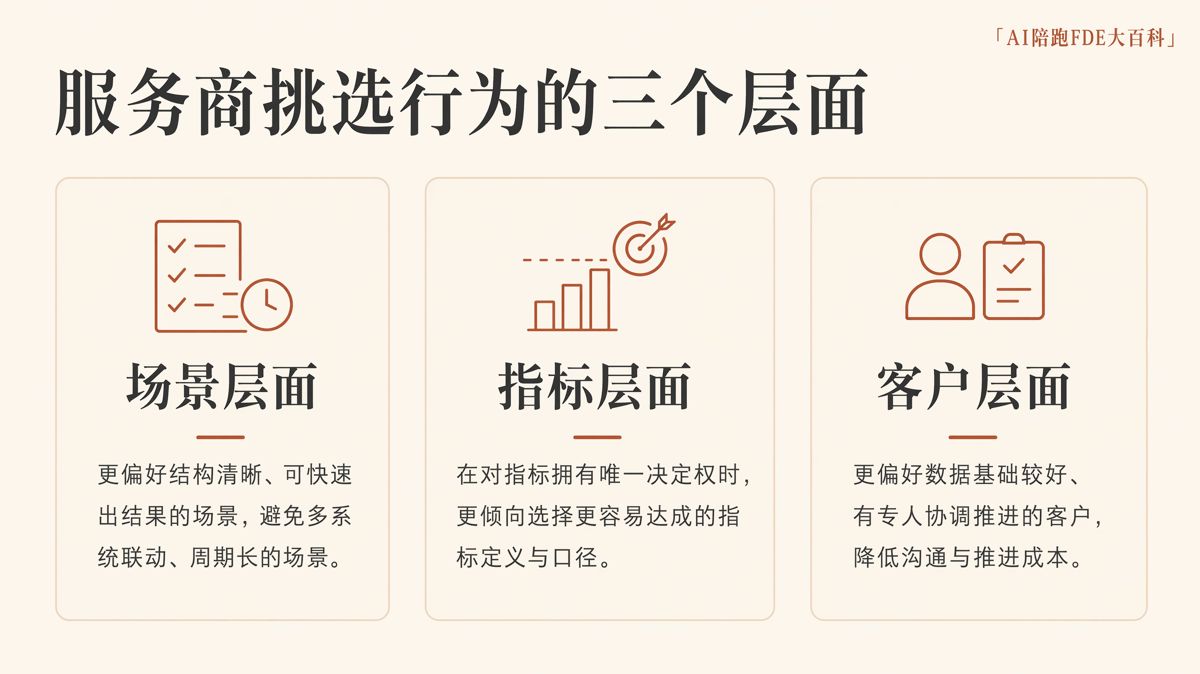
Three Ways Vendors Screen Incoming Projects
1. Is the use case suitable?
Tasks like content generation and customer support triage feature clear workflows and standard outputs. Performance shifts can be observed quickly, making them well-suited for performance-based contracts.
By contrast, supply chain optimization or cross-departmental workflow redesigns involve legacy systems, multiple stakeholders, and long implementation cycles. With so many variables outside their control, vendors approach these requests with far more caution.
2. Can the metrics be verified cleanly?
Take a goal like "increasing content production." You could measure the number of pieces published, or you could measure the actual business conversions those pieces generate.
Publishing volume is easy to measure in the short term. Conversion volume reflects genuine business value, but it is influenced by product quality, pricing, distribution channels, and sales execution. If the vendor defines the metrics unilaterally, they will naturally favor metrics that are easy to achieve and prove.
3. Does the enterprise have the operational readiness?
Companies with clean data, dedicated point people, and steady cross-team coordination can execute a rollout effectively.
Companies with fragmented data, broken workflows, and internal friction often need help the most, yet they will struggle to find a vendor willing to work on pure performance fees. The vendor cannot fix internal organizational bottlenecks, but would share the financial penalty if the targets fall short.
This screening does not inherently harm the buyer. When a vendor declines a scenario unfit for performance fees, it often shows they understand operational boundaries.
What you should demand is a complete assessment: Did they evaluate all of your requested use cases? Which ones are viable now? Which require prerequisite work first? Which should be avoided entirely? If a vendor only presents the easy targets and ignores the rest without explanation, you cannot evaluate whether their recommendations are sound.
Four Specific Questions to Ask Before Signing
1. Who sets the metrics, and how are they calculated?
Vague targets like "higher efficiency," "increased capacity," or "improved performance" cannot be used to settle an invoice. You must define: * Which exact workflow step is being measured * Which specific data points are tracked * The exact mathematical formula used * The duration of the audit window * Which system the data comes from * Who is responsible for verifying the numbers
If the vendor proposes, calculates, and audits the metrics alone, they hold unilateral control over whether the project succeeded.
2. Why start with this specific use case?
A comprehensive proposal assesses your current operations and explains which workflows fit performance pricing and which require data cleanup or workflow adjustments first.
When a vendor recommends a specific starter scenario, ask for the reasoning behind it: Why is this one faster to validate? Are your current operational conditions sufficient? If you chose a different scenario instead, what specific risks and bottlenecks would arise?
A vendor may suggest deferring complex workflows, but they must provide clear business rationale. You need an evaluation of your full operational scope, not just a plan engineered for easy billing.
3. What happens after the pilot succeeds?
Piloting one workflow before expanding into other departments is standard practice.
Before work begins, define the criteria for moving to the next phase: What benchmark triggers expansion? Who manages the rollout? What additional staff, data feeds, or software tools are needed? If the pilot misses its benchmark, do you adjust the plan, extend the test period, or end the contract?
Without explicit transition criteria, projects often linger in pilot mode indefinitely.
4. What deliverables does each fee cover?
Your agreement should break down costs line by line: * Diagnostic audits and strategy design * Tool and platform deployment * On-site personnel support (including headcount, day rates, and assigned tasks) * Data tracking, reporting, and retrospective reviews
Each cost must tie directly to specific deliverables and outcomes. A lump-sum quote without a scope breakdown makes it impossible to tell what you actually purchased.

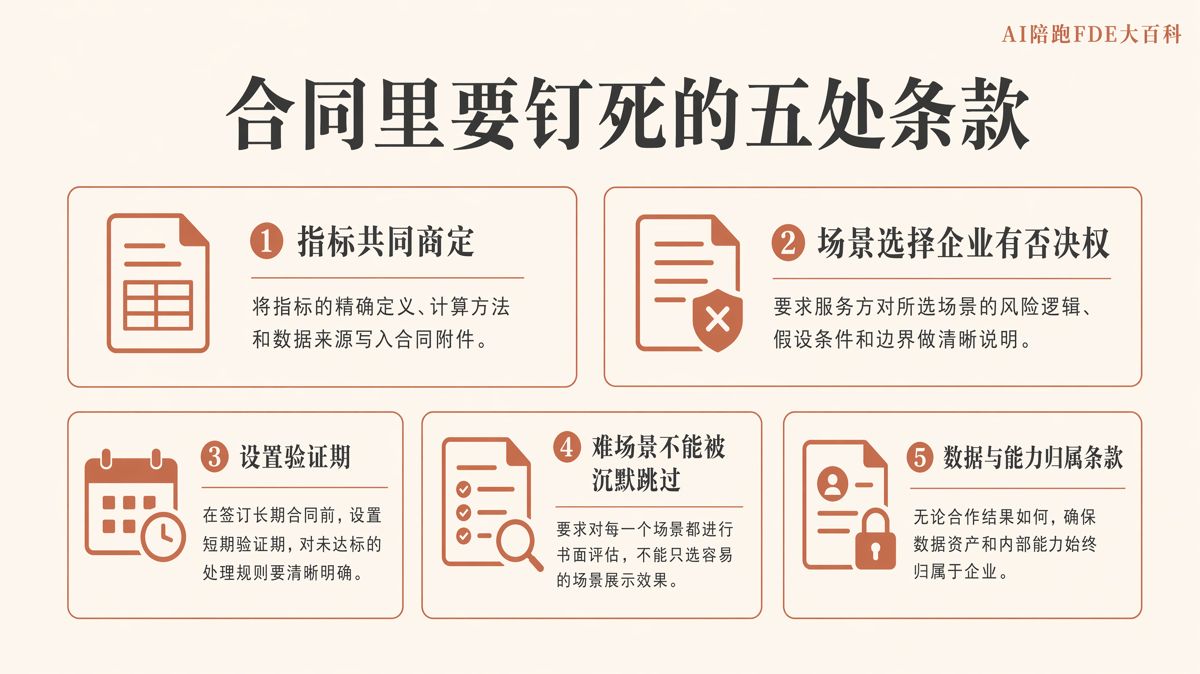
Five Must-Haves in the Contract
1. Metrics attached as a binding appendix
Metrics must specify output volume, unit cost, response times, or other agreed benchmarks for specific workflow stages. The appendix must include the audit window, data sources, and calculation methods. Neither party should be permitted to alter these definitions unilaterally at billing.
2. Written evaluations for every submitted use case
If your company has several AI use cases, require the vendor to document each one: which qualify for performance pricing, which require fixed-scope project fees, which should be postponed, and the operational reasons behind each determination.
A vendor can decline a use case due to high execution risk, but they should not omit it without an explanation.
3. Shared scenario selection with client veto power
Vendors can recommend implementation priorities based on technical risk, but use case selection must be a joint decision. Your company should retain final say over which workflows enter validation and whether they expand further.
4. A defined validation period before long-term commitment
Establish a one- to three-month validation period. The contract should outline specific remedies if benchmarks are missed, such as adjusting the workflow, crediting initial setup fees toward future work, or ending the engagement cleanly.
This allows both sides to confirm operational viability using real performance data before scaling investment.
5. Clear ownership of data, knowledge bases, and team capabilities
In this context, an enterprise knowledge base refers to the structured internal documents and data assets prepared for AI tools and employees to reference.
Even if a pilot falls short, your company's proprietary data, custom knowledge bases, and team training should remain your property. The contract must state who owns these assets, how they will be delivered, and that your company retains full rights to use them after the contract ends.

Performance Pricing Protects Budgets, Not Good Judgment
Performance-based pricing reduces financial downside, but a vendor cannot resolve internal silos, incomplete data, or operational inertia on their own.
Vendors screening projects is standard practice. What matters is whether the vendor explains their criteria openly, commits specific deliverables to the contract, and agrees to shared governance over metrics and validation.
When you know exactly what each fee buys, how results are verified, and how unmet targets are handled, performance pricing becomes a genuine risk-management tool.
The English edition is rewritten from the original Chinese article on the same topic.

Starbox AI is an AI marketing company based in Hangzhou, China. This article draws on Starbox project work. Please credit the source when quoting.
Related reading
 AI Adoption
Can One AI Operator Really Replace 10 People?
Claims of 10x headcount cuts count generation speed, not QA and rework. Real efficiency measures net pipeline hours saved.
Oct 22, 2026 · 6 min read
 AI Adoption
Bought Basic AI and Seeing Zero ROI? A 4-Step Activation Playbook
Activating entry-level AI is not about model parameters. Turn open chat boxes into defined operational stations with clear inputs, templates, and QA checklists.
Oct 22, 2026 · 6 min read
 AI Adoption
Why One-Click AI Fails at Work: How to Pick Enterprise Agents
One-click AI tools seem easy, but their first-draft accuracy is terrible. Real business ROI requires multi-step workflows with your own knowledge base.
Oct 21, 2026 · 6 min read