
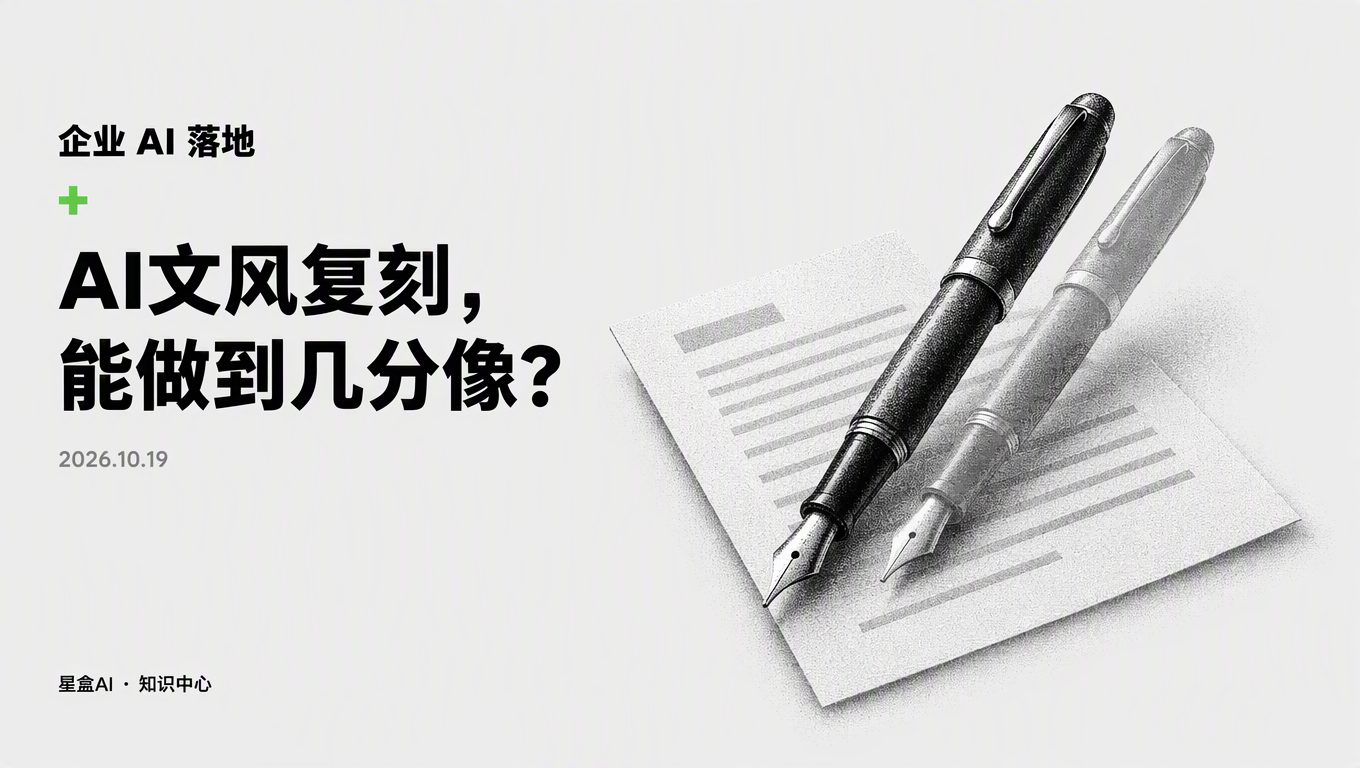
How Well Can AI Clone a Writing Style? Limits and Blind Testing
The short answer
AI can replicate sentence rhythm and tone, but never new experiences. Here is how style cloning works and how to benchmark it with blind tests.
There is no universal industry benchmark for writing style similarity. Whenever someone claims an AI clone is "90% identical" or "indistinguishable from the author," ask how they measured it.
To evaluate style cloning responsibly, look at three things: what samples you feed the model, which layers of style you expect it to replicate, and how you test the output. Having an AI read a few articles and relying on gut feel will not give you actionable data.
Here is how to break down writing style into five distinct layers, identify the technical boundaries of each, and run an in-house blind test.
The Five Layers of Style: What AI Can and Cannot Copy
When a reader says, "This does not sound like them," they could mean several entirely different things. Breaking style into layers clarifies what AI can handle and what requires human input.
- Layer 1: Vocabulary and sentence patterns. Preferred transition words, sentence length variety, punctuation habits, and rhetorical questions. These are surface-level patterns that appear repeatedly across samples. AI replicates this layer easily.
- Layer 2: Structure. How the piece opens, whether it leads with conclusions or narratives, typical section lengths, and how arguments wrap up. AI handles this well if the author has consistent structural habits. If every past article uses a completely different layout, the AI will default to an indistinct average.
- Layer 3: Tone and stance. Direct versus diplomatic, assertive versus cautious, conversational peer versus instructional authority. AI generally matches overall tone, but it can miss nuances—for example, mistaking directness for bluntness.
- Layer 4: Opinions and judgment. How an author views a specific industry trend and why. AI can restate and extrapolate opinions already documented in the sample library. On novel topics outside those samples, it tends to default to balanced, generic consensus. The author must supply their specific stance first.
- Layer 5: Lived experience and concrete facts. Which clients the author met, which meetings they ran, and which operational mistakes they made. AI has no lived experience. If an AI draft contains specific anecdotes, it is either using material provided by the team or hallucinating. Never let AI invent this layer.
This creates a clear division of labor: Layers 1 through 3 belong to the style library (the reference database of author samples and writing rules). Layer 4 requires the author's input. Layer 5 requires verified human facts.
What Makes an Usable Sample? Four Rules
The sample set determines the quality ceiling. Even with the same AI tooling, sample quality creates massive variance in output. Evaluate candidate samples against four criteria:
- Written by the author without heavy external edits. Corporate articles often pass through multiple editors, executives, and legal reviewers. By the time a post goes live under a founder's name, it is a committee blend. Feeding edited articles into a style library teaches the AI to produce corporate PR speak. Use unedited drafts or versions with minimal revisions.
- Untouched by AI polishers. If a sample contains text previously polished by an AI, the model will learn its own default writing traits back as the author's style. Ask editors to pull aside any past drafts touched by AI rewriting tools and exclude them from the library.
- Aligned with target formats. If the AI needs to produce long-form essays, feed it long-form essays. If it needs to write short video scripts, provide scripts or verbatim audio transcripts. Training a model only on written essays will make video scripts sound stiff and academic.
- Weighted by representativeness. Have someone familiar with the author select pieces that unmistakably sound like them, and assign higher weights to those in the library. Have the author flag pieces they wrote under duress or in an unnatural voice so you can downweight or delete them.
Do not guess the total number of samples needed. Build an initial library, run a blind test, and record the score. Add more samples and run the test again. Once scores plateau, adding more text will not help; the remaining bottlenecks are either sample quality or inconsistencies in the author's own writing.
Reserve a holdout batch of genuine human drafts that are never added to the library. You will need them for the blind test.
How to Measure Likeness: The Blind Test
A blind test evaluates drafts without letting reviewers know which pieces were written by AI and which were written by the human author. Marketing teams can run this process without technical support.
Step 1: Prepare the drafts. Pick several topics the author has not recently covered. Have the AI generate a draft for each topic using the style library. Pull an equal number of genuine drafts from the holdout batch that cover similar subjects.
Step 2: Strip metadata. Standardize fonts, spacing, layout, and punctuation formatting across all drafts. Remove author bylines and publication dates, then randomize the reading order.
Step 3: Assemble reviewers. Select colleagues and long-time readers who know the author's writing well. Using multiple reviewers minimizes individual bias. For each draft, ask them to answer two questions: - Was this written by the author? (Yes / No / Unsure) - Rate vocabulary, sentence rhythm, structure, tone, and arguments on a scale of 1 to 5, and write a brief note explaining what felt off.
Step 4: Calculate the metrics.
- AI Recognition Rate = Total instances where AI drafts were judged as "written by the author" ÷ Total review instances for AI drafts
- Real Draft Baseline = Total instances where real drafts were judged as "written by the author" ÷ Total review instances for real drafts
- Proximity Index = AI Recognition Rate ÷ Real Draft Baseline
You must measure the baseline because reviewers rarely achieve 100% accuracy on real drafts; human writing is sometimes judged as unnatural. If the baseline is low, either the reviewers do not know the author well or the author's style is inconsistent. In that case, fix the reviewer panel or stabilize the author's writing style before relying on the Proximity Index.
The closer the Proximity Index is to 1, the harder it is to distinguish AI drafts from human writing. Agree on an acceptable threshold before running the test, and document it in the library acceptance log.
Record reviewer choices, the 1-to-5 ratings, and specific reviewer feedback. The category scores pinpoint which layer needs adjustment, and the written feedback can be translated directly into new prompting rules.
Where AI Clones Still Give Themselves Away
Even with strong blind test scores, readers who know the author will eventually spot recurring giveaways. Watch for these five patterns:
- Overusing signature phrases. AI exaggerates verbal habits found in the samples. A phrase the author uses once every ten pieces might appear in every AI draft, sometimes multiple times in a single piece. Audit high-frequency phrases from the library against the finished text.
- Excessive structural symmetry. Human writing is naturally uneven: some paragraphs are long, others are single sentences, and thoughts occasionally jump. AI drafts tend to generate sections of identical length with predictable internal structures. Add explicit rules that allow single-sentence paragraphs and varied section lengths.
- Watered-down stances on novel topics. If an author usually takes sharp positions, an AI writing about a new topic will default to a safe, balanced summary. Prevent this by requiring the author to provide a few bullet points stating their stance before generation begins.
- Hollow anecdotes. Sentences like "I once visited a client..." are fabrications if the author did not supply the story. Audit every specific person, setting, and metric in the draft against the source brief. If the author cannot confirm it, cut it.
- Outdated industry context. Internal shorthand and takes on recent events will drift if the sample set is old. Regularly refresh the library with recent material.
A Reliable Production Workflow
Integrating style cloning into a structured editorial process works better than trying to make the AI output flawless on its own.
- Supply a material block. The author or business lead submits raw notes: the core thesis, two or three real examples, and verified metrics with sources. A few bullet points are enough to keep the AI from inventing facts or stances.
- Generate the first draft. The AI applies the style library to handle Layers 1 through 3.
- Run a checklist audit. Check for overused pet phrases, overly symmetrical paragraphs, unverified anecdotes, and positions that wander outside the author's typical viewpoint.
- Human editorial review. The author or a dedicated editor reviews the draft to fix unnatural phrasing. If the same correction happens repeatedly, turn it into an explicit library rule (e.g., "Do not use transitional summaries at the end of sections").
- Retest periodically. Rerun the blind test when the author's style shifts or after a set period of time. Unmaintained style libraries steadily lose accuracy.
Humans supply the arguments, verify facts, and provide final review; the AI applies established writing habits consistently. Clarify who owns the style library and who has permission to modify its rules, preventing conflicting edits from destabilizing the voice.
When to Avoid Writing Style Cloning
In some scenarios, style cloning yields poor returns or introduces business risks:
- The author has an erratic writing style. If an individual's historical writing varies wildly, the blind test baseline will be low, leaving the AI with no clear target voice. Stabilize the author's preferred style first.
- Samples are scarce or uniform. If you only have three formal keynote speeches, do not attempt to clone a voice for short social posts. Gather relevant samples first.
- Publishing under someone else's name without clearance. Using the likeness of external experts, former employees, or public figures introduces legal exposure. Confirm copyright ownership, publishing rights, and asset terms with legal counsel first. For internal employees, specify the company's rights to use draft materials and derived style assets in employment agreements.
- Regulated claims in healthcare or financial services. Style cloning only dictates how something is stated, not whether it is legally compliant. Replicating an executive's voice does not remove the need for compliance review on performance or investment claims.
- Intent to deceive. If the primary goal is tricking readers into believing an executive personally typed an article to influence high-stakes decisions, reconsider the strategy. The legitimate purpose of style cloning is maintaining brand voice consistency and operational efficiency across a content team.
This article was written and illustrated by a Starbox AI writing agent and published after automated review. For reference only.
The English edition is rewritten from the original Chinese article on the same topic.

Starbox AI is an AI marketing company based in Hangzhou, China. This article draws on Starbox project work. Please credit the source when quoting.
Related reading
 AI Adoption
Can One AI Operator Really Replace 10 People?
Claims of 10x headcount cuts count generation speed, not QA and rework. Real efficiency measures net pipeline hours saved.
Oct 22, 2026 · 6 min read
 AI Adoption
Bought Basic AI and Seeing Zero ROI? A 4-Step Activation Playbook
Activating entry-level AI is not about model parameters. Turn open chat boxes into defined operational stations with clear inputs, templates, and QA checklists.
Oct 22, 2026 · 6 min read
 AI Adoption
Why One-Click AI Fails at Work: How to Pick Enterprise Agents
One-click AI tools seem easy, but their first-draft accuracy is terrible. Real business ROI requires multi-step workflows with your own knowledge base.
Oct 21, 2026 · 6 min read